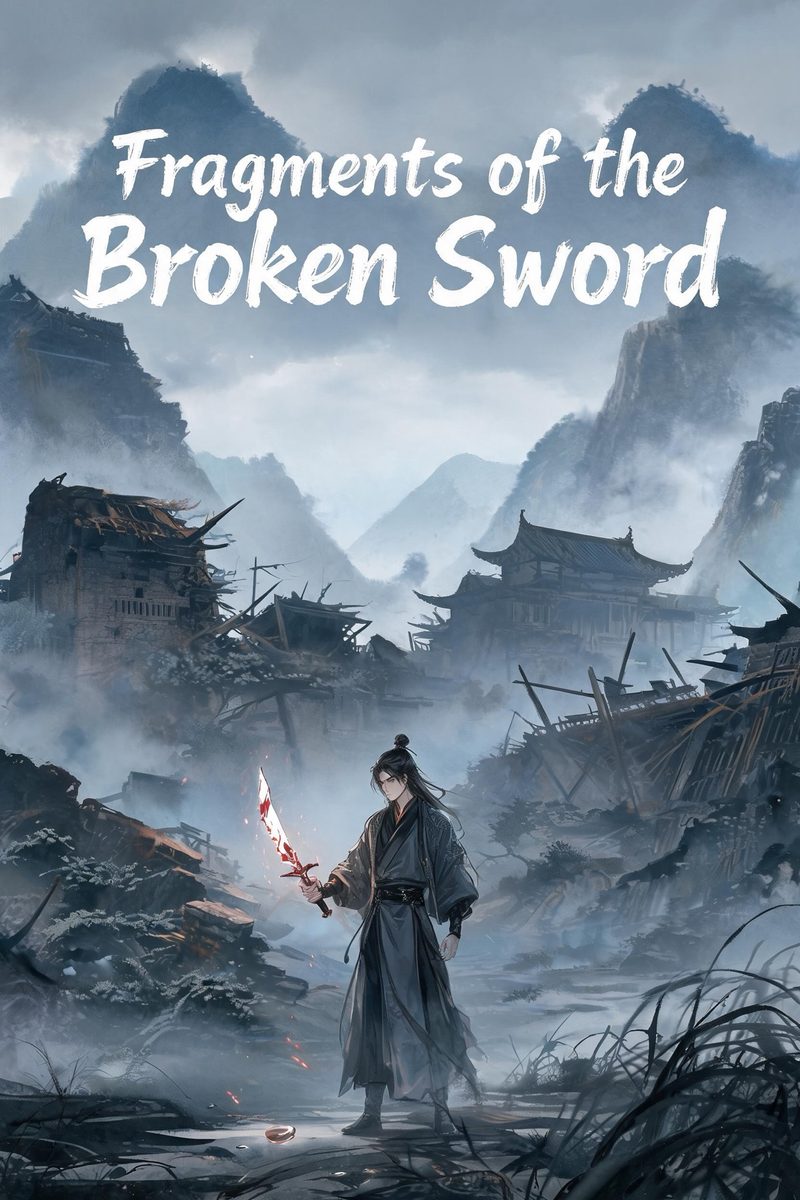
Fragments of the Broken Sword
by PageCrave Editorial
The wine smelled like home, and that was the first cruel thing about the night.
Lu Yan, scullery servant of Cloudrest, was born in Qinglan Sword Manor, son of the man who led the Nine Rivers Table — the court of heroes that ruled the rivers and lakes — until fifteen years ago, when the manor burned with forty-one blades inside it and the verdicts named his father the butcher of Cold Spring. Lu Yan was nine years old. He has spent seven of the years since learning to be furniture: shoulders bowed, eyes down, invisible as dust, and remembering everything.
Then a cask of his father's plum wine, seized as tribute, is served to the Chief's own table, and the smell climbs into Lu Yan's skull and will not come free. Before midnight he is running for his life, and behind his eyes a lockbox with nine sheaths stands open for the first time. His father's art was split into nine fragments and sealed in his son's blood. Each fragment wakes only when he is near death in a fight, and each opening takes a piece of his childhood as the price. A footwork drill here. The sound of a father teaching there. The smell of plum wine. His father's face.
Hunted by the hounds of the Shadow Bureau, hired and hunted again by the Iron Banner caravan whose sealed white wagon carries a town's disappeared, Lu Yan falls in with Shen Mei, an herb-woman who counts everything — pulses, coins, exits, breaths — and whose little ledger-book already has a page headed The Sound of a Father Teaching. Together they follow the paper seals up the river roads: a page of his father's hand copied wrong on purpose, a temple bell that rings with no rope, a walled cellar door that has begun to eat, and a Chief who has spent thirty years feeding it and calling the hunger peace.
The truth is older and colder than any verdict. The fragments are nine pieces of a sword no forge ever made, a sword that ends kings, broken six hundred years ago and locked behind its own shattered body — and the Table of heroes was never a court at all. It was a set of wardens, one fragment bound to each of their bloodlines, and the door beneath the mountain has spent six centuries learning how to collect them. Now the Chief has built a platform of anchor-iron over the cellar, called it justice, and invited the whole Jianghu to watch a ghost unmasked. What he means to unmask is the key. What the door means to open is everything.
One cut was never written in any school: the refusal — to stand in the wine-keeper's place, wanting nothing, and say no to a door that has out-waited mountains. Lu Yan's father reached for it and bought two hundred deaths. The last sword-saint practiced it for fifteen years in the dark and lost himself to the wearing instead. Lu Yan has four sheaths open, a woman who counts at his shoulder, and one night to learn the only stance with no page — because the door is done whispering, the feast is seated, and the empty chair on the platform has waited six hundred years for a sitter.
In our reading guide: This time you're rooting for the dungeon.