The Ninth Harvest
by PageCrave Editorial
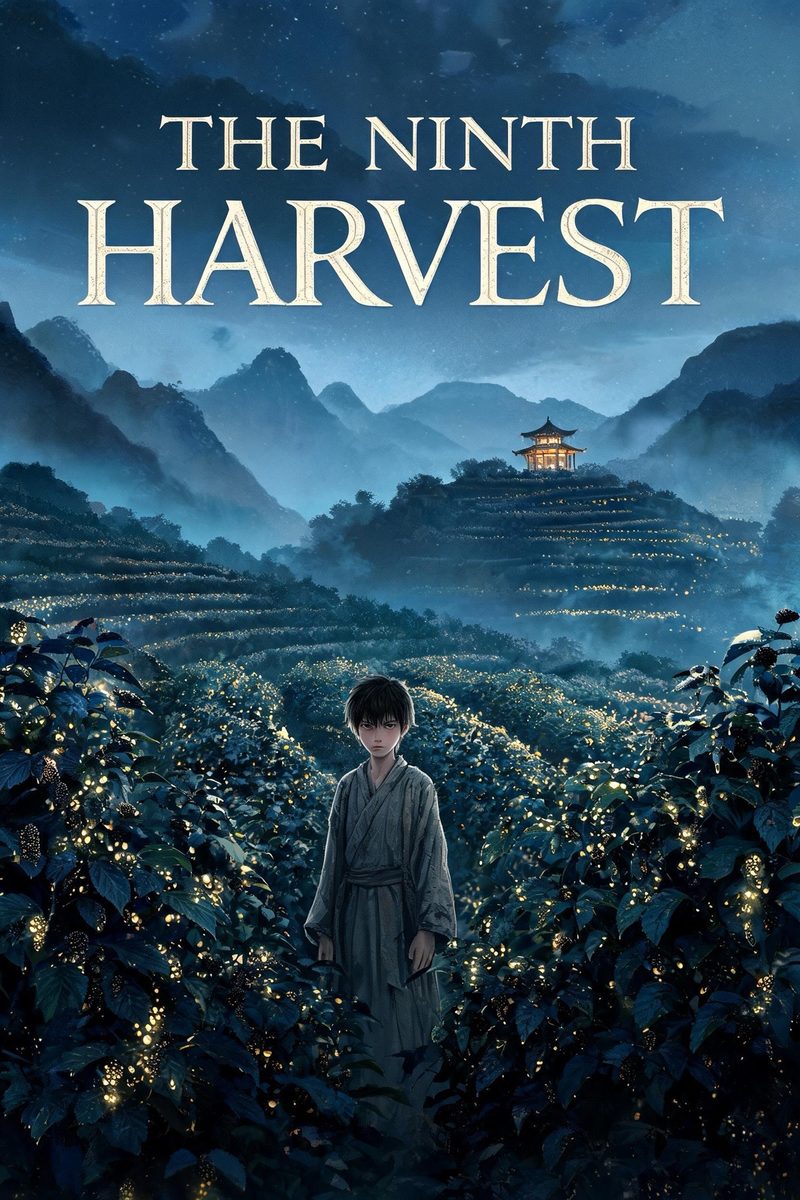
They call the dew that gathers on the Sweetdew Sect's terraces the sweetest on the mountain, and the slaves who walk the mulberry rows at night call it something else, because they know what it is gathering for. Every seven years the sect holds a harvest, and the harvest is not mulberry leaves. It is people. A blind old copyist keeps a ledger of the taken in charcoal, an elder keeps the rows quiet with a pair of silver scissors, and in a pavilion above the ninth row something very old has spent seven hundred years turning a mountain into a granary. It is missing one thing: the tenth crop, the one that makes a storehouse into a mouth.
Lu Sang remembers dying. He remembers a laboratory of soft light where children were scored with fine straight lines so their channels could be indexed, and he remembers the last thing he learned there: an art the sects amputated from their own scriptures centuries ago and could not burn, because it lived where fire does not reach — in work songs, in slave counts, in the meter of rice pounded at midnight. The Ninefold Dew-Siphon Sutra. A drinking art with no returning half, the manuals say. The manuals are wrong.
Reborn as a sick fourteen-year-old row boy on the morning of the harvest census, Lu Sang has two goals and one rule. The goals: get his mother off the south rolls, and never be written into anyone's ledger again. The rule, older than this life: when you are being drunk, you are allowed to bite back.
He expects to hide, but the mountain notices him: root-stones glow when he walks past, the evening bell gains three breaths a night, a drained creditor returns with silt in his eyes and a hatchet, and Elder Wan Qiu — the pruner, the blade who keeps the rows quiet — reads three rings rising on his wrist and kneels on a dirt floor to ask for the one line of scripture the founding fire failed to burn. Above them all, in a pavilion that smells of wet iron, the ninth elder takes an interest. It speaks in the voices of the dead. It has been ripening Lu Sang since the night he arrived, and it would very much like him to consent.
Rite night is coming early this year; the bell says so, and the Wheel, older than the founding stone, has already begun to warm.
To survive it, Lu Sang will have to do what no crop on this mountain has ever done: refuse. He will need a blind man who cannot speak the art but carries its whole text, a captain who can teach four thousand slaves to stand with a rhythm hidden in a song, a disgraced elder with nothing left to lose, and a smuggler's cold ledger of every barrel that ever rolled south. And he will need the chart scored into his own skin: the map of every root the granary holds, and the one empty cell where the tenth crop goes.
The nine refuse consent. The field remains. The farmer changes.
This is a story about the arithmetic of the powerless, the patience of the stolen, and the oldest count on the mountain: two short, one long, two short — something's walking.
In our reading guide: This time you're rooting for the dungeon.