Quartermaster King
by PageCrave Editorial
Sergeant First Class Derek Yun told a full colonel, in writing, that the man's fuel figures were impossible. The colonel agreed about the writing. The Eighth Army posts its inconvenient honesty to Forward Depot Seven: a fence line of rusted Quonset huts at the dead end of a rail spur, where the inventory has not reconciled in fourteen months and careers are sent to be forgotten.
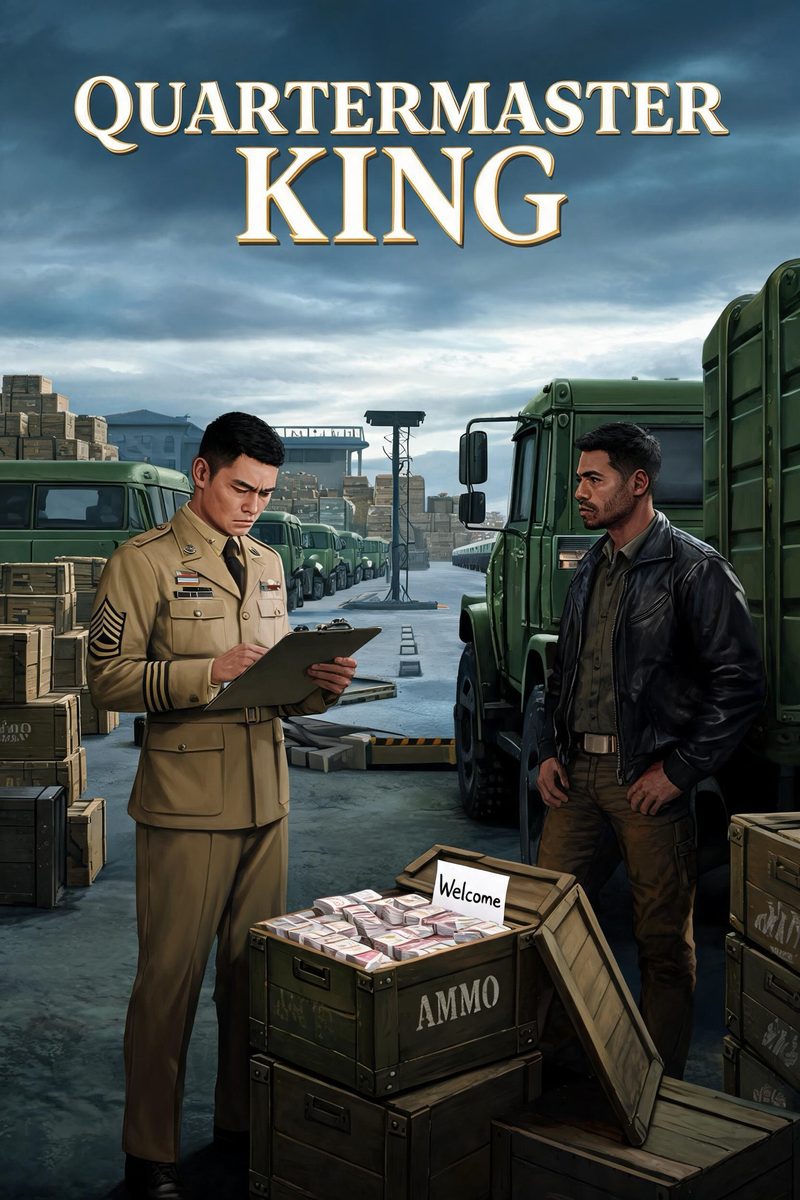
Derek does not stay forgotten, because Derek was raised behind a storekeeper's counter, and he carries a gift the army has no form to record. Numbers come to him unbidden. Set him before a sealed crate and the count arrives whole: the weight, the density, whether the packing frames hide anything they should not. The depot comes to call the gift the Eye, and on his first night it tells Derek that a certain ammunition crate is filled, carefully, with bundled banknotes.
What begins as a sergeant refusing to sign for phantom stores turns into the audit of a war. Behind the depot's petty thieving Derek finds the machine: a corruption network two decades deep, with its own callsigns, its own couriers, its own accountants, and its roots in the Director of Supply's own building, where Raymond Walsh, the silver man who has never once audited his pen, presides over a system designed so that no document ever reaches him stained. When Derek counts too loudly, the machine answers the way it answers everyone. A young corporal named Reyes dies with his brake line cut, a message priced cheaper than a funeral, and the next work order schedules Derek himself to go off the same grade, filed as grief.
The machine is not Derek's only enemy, and the colder one wears a uniform. Across the lines an enemy staff has read the army's registered strength and decided the war can still be won in one stroke, in one place: the winter supply system, the mountain road called the Loop, the throat of an entire army group. To feed the offensive, Derek must turn two hundred kilometers of dead trucks and gravel into a timetable that never misses, publish every number where every driver can read it, and make the largest convoy in the history of the war move through the northern cut at night, once, with no second chance.
Victory arrives the only way it ever arrives in this army: on paper that foots. One by one the machine's own instruments are turned against it, a pen here, a stamp there, an inspector's shelves of mirrored ledgers surrendered whole. By the end of the winter the soldier who was posted to be forgotten is running the Director's building, the country's accounts are being read aloud at breakfast in market squares, and Derek's father, whose good name an inquiry once stripped in public, takes a witness chair of his own with thirty years of worn ledgers under his arm.
But the machine left the account open, the enemy has one last army in the passes, and a throne of paperwork is still a throne. In the valley's oldest usage, a king is simply the man who feeds you, the one who can be made to show you the larder. Derek Yun never wanted a crown. He wanted the count to come out right.