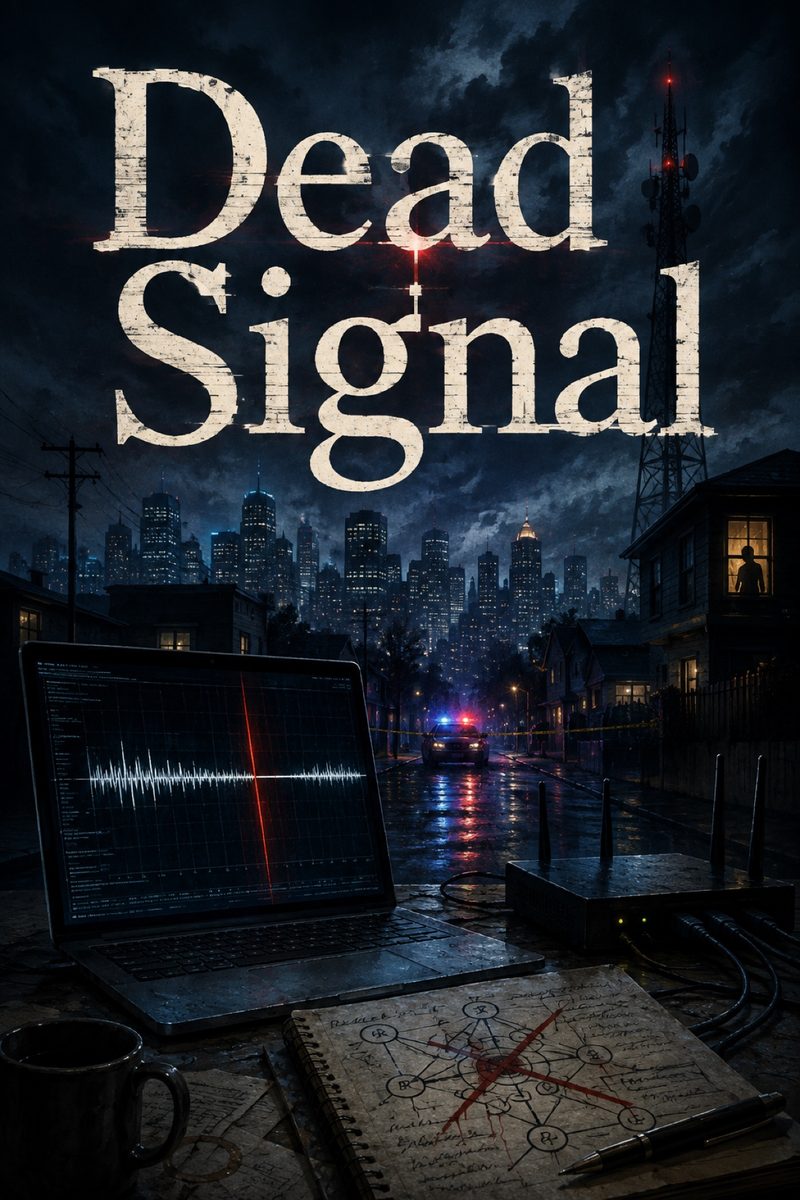
Dead Signal
by PageCrave Editorial
Caleb Finn works the overnight shift at the Smart City Hub, where his job is to autopsy the calls that end wrong: the dead signals, the data that stops mid-stream, the quiet where a city's emergencies used to be. He is good at it in the way that makes supervisors nervous, because he does not accept weather as an explanation.
At 04:17 one morning, the east grid loses eleven minutes of emergency traffic. Not a glitch. An absence, cut so clean it looks like policy. Among the vanished calls is a woman's whisper that dispatcher Mara Ellis still hears in her sleep: the lights were wrong. That same night, a councilwoman from the east side dies of a cardiac event that nobody thinks to question.
Finn questions it. Pulling the dirty layers beneath the city's honest dashboard, he finds Router Seven, a node decommissioned on paper three years ago by a certificate bearing his own rubber-stamped signature, still warm, still billing, still swallowing minutes. The hole rides a hidden bypass rule marked temporary and held for audit, and it is exactly six hundred and sixty-eight seconds long.
Then he finds the other holes. South grid. West grid, twice. North grid, under a dedication speech about safety. Four districts, one duration, one habit, and a hidden calendar that has scheduled the next silence under a civic keynote, in front of a livestream.
Against him stands Castell, counsel for the vendor that sold the city its pretty network, a man who arrives with fruit and leaves with leverage. Around Finn gather the only allies a bureaucracy can spare: Okoye, a supervisor who has buried one career already and is willing to bury another; Mara, whose ears are her license and whose memory is now evidence; a facilities technician with fourteen years of carbon copies; and a junior budget analyst who whispers tell them the money moved twice, then vanishes from the record himself.
The trail runs from a retired splice in a sub-basement to a cost center born nine days after a keynote, from a deletion truck at a loading dock to a ledger whose final row pays a lawyer to lose. Behind it all sits a director whose title, Continuity and Public Confidence, reads like it was invented for a dedication speech, and above him, the signatures on pages nine and ten of an audit that was certified destroyed, except for the one copy a stamp-hungry intake machine refused to refuse.
Dead Signal is a procedural made of receipts: hashes, stamps, quarantine queues, and the quiet war between people who keep records and people who keep secrets. The reforms give Finn a city box that cannot lie and a dispatcher's veto that cannot be flashed with a smile. They do not give him safety. Tools outlive their authors, and on the night the puppet burns, a new account wakes in the intake queue under a poet's name, holding exactly one grant, a taste for unread mail, and a comment field that reads recitation.
The signal is loud now. The city finally listens. Somewhere in the queue, though, something is measuring how fast the city bleeds, and it has just finished counting.