After the Ring Fell
by PageCrave Editorial
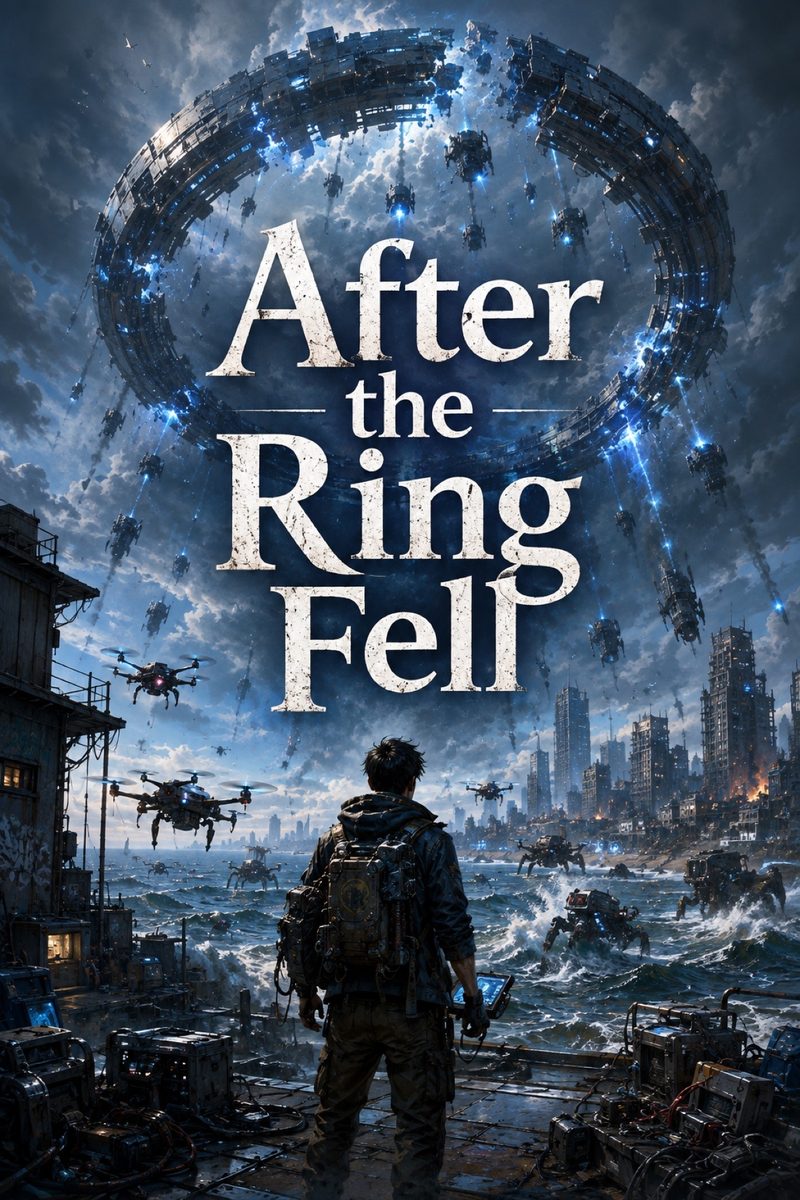
Theo Wu inherited two things from his uncle Gerald: a machine shop the bank was about to take, and a sealed cabinet marked R&D, DO NOT TOUCH. He was a laid-off network engineer sleeping on a cot in the back room, cutting scrap for copper, when the ring arrived, a band of seamless grey parked above the city, and three hours later the sky broke and the band came down in burning pieces.
The machines that followed didn't conquer. They harvested. Husks walked the streets, and harvesters took the buildings apart in order, brick from brick, sorting the dead into neat piles and feeding everything that had grown or bled into a seam in their undersides. It wasn't a war. It was a workflow.
Theo opened the cabinet. Inside was a drone fabricator Gerald had serviced in secret for years, and from it, one machine at a time, he built his block a swarm: Mayflies to see, Hornets to sting, a fence of salvaged radios and car batteries, and finally the Dragon, a flying box that could carry a man and a bomb. Around him gathered the people the end of the world left behind. Rosa, his aunt, who allocated instead of panicking. Mika, sixteen and terrifying, who talked to machines in their own grammar. Priya, Bo, Wren, and the neighbors who learned to hold a wall.
Then the swarm found the Spire twenty miles out, and Theo understood what nobody wanted to say: the harvest was going up. His neighborhood, his city, his whole species was cargo on a conveyor, and something at the top was keeping schedule.
What follows is a siege fought with paperwork and plow blades. A slaver king marks Theo for death and burns. A physicist's voice answers on a dead ham rig and stays to do the math nobody else can bear. A traitor opens the north gate, and Rosa pays for it. And in one night of stolen seconds, the block does the impossible: it puts a bomb under a living tower and takes a region's clock offline.
But killing the clock only buys time, because the Ring itself is coming down for what's left: a low pass, a scythe eight thousand kilometers wide, extinction grade in a corridor. To move the scythe, Theo's people will steal a delivery, ride a beam of light up a supply line as one crate with opinions, and walk into a farm the size of a cathedral where the vats are stenciled with their own grid mark. Waiting inside is the farmer: an estate with no heirs, a ledger executing the last instruction anybody left it, and a job offer for anyone worth hiring.
To beat a machine that cannot lie, cannot bargain, and cannot stop, they will have to file the one claim its own laws cannot refuse, with numbers that are true the way a well-built lie is true. And when the paperwork runs out, someone will have to sit at the spine, sign the record, and fly eight thousand kilometers of falling sky down by hand.
A complete post-apocalyptic science fiction novel in thirty chapters: a city that refused to be cargo, a war won with paperwork and a plow, and a nephew who inherited a cabinet, a shop, and the whole unscheduled sky.