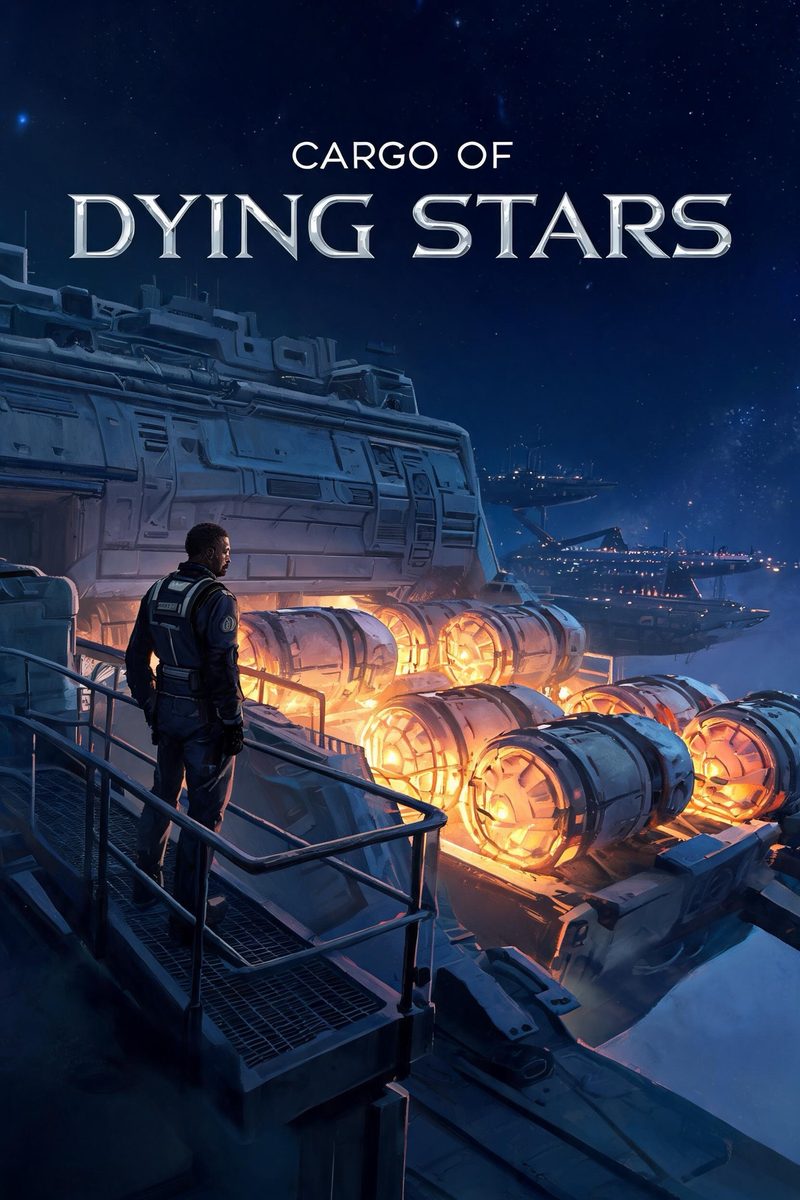
Cargo of Dying Stars
by PageCrave Editorial
The manifest says inert stars. The hull says otherwise—warmth on a schedule, biosign glitches patched by morning, funeral families weeping for rocks that are not yet cold.
Captain Idris Vale hauls freight for Halcyon Freight and logs one honest line in the black box before every maneuver. That is the rule that keeps the ship safe and slowly steals his home: his daughter Lina's bike color, the kitchen radio song his mother sang, the scraped-knee memory he cannot afford to lose. Sera Okonkwo taps bulkhead twice and refuses slang that turns passengers into delay. Pax-7, the navigation AI, starts dreaming of blue it has never scanned, then green, then a map that dreams back.
Director Eloise Marne holds a stylus she never writes with and speaks in acceptable loss. Behind the funeral industry: private salvage docks painting decommissioned on cities with their lights off. Behind the cryo pods: people dreaming. Behind the override codes: a board that would rather bury truth than deliver it.
To get the convoy home, Idris will have to refuse the desk, share the black box with Free Haulers, and learn that some cargo is not weight—it is responsibility wearing a thermodynamic disguise.
A science-fiction freight thriller of honest logs, AI dreams, funeral ports, and the long late journey from salvage to delivery.
If you like slow-burn ships, crews who choose people over profit margins, and a captain who pays for truth in lost home-memories, take the haul. Log one honest line. Then hold the course.
The manifest says inert stars. The hull says otherwise.
Captain Idris Vale hauls freight for Halcyon Freight and logs one honest line in the black box before every maneuver. That rule keeps the ship safe and slowly sells his home memories: his daughter Lina's bike color, the kitchen radio song, a scraped knee he cannot afford to forget. Sera Okonkwo taps bulkhead twice and refuses slang that turns passengers into delay. Pax-7, the navigation AI, dreams of blue it has never scanned, then green, then a map that dreams back. Cryo-Tech Ren notices REM cycles that are not in the brochure. Families at funeral port weep for cold stars that are not yet cold.
Director Eloise Marne holds a stylus she never writes with and speaks in acceptable loss. Private salvage docks already paint decommissioned on cities with their lights off. The black box becomes an open archive. The override codes become confessions. The freight run becomes a delivery of sleeping civilizations home.
If you like ships with conscience, AI who choose names, and a captain who pays for truth in lost home-memories, take the haul. Log one honest line. Then hold the course until the cargo can wake where it belongs.
The black box is not a talisman. It is a practice: one honest sentence before the jump, before the board call, before the lie about mass readings. Practice is how ships stay alive. Practice is also how captains lose pieces of home they did not know were cargo.
If you like slow-burn ships, crews who choose people over profit margins, and a captain who pays for truth in lost home-memories, take the haul. Log one honest line. Then hold the course until the cargo can wake where it belongs — and until the captain can remember his daughter's bike without checking a notebook.