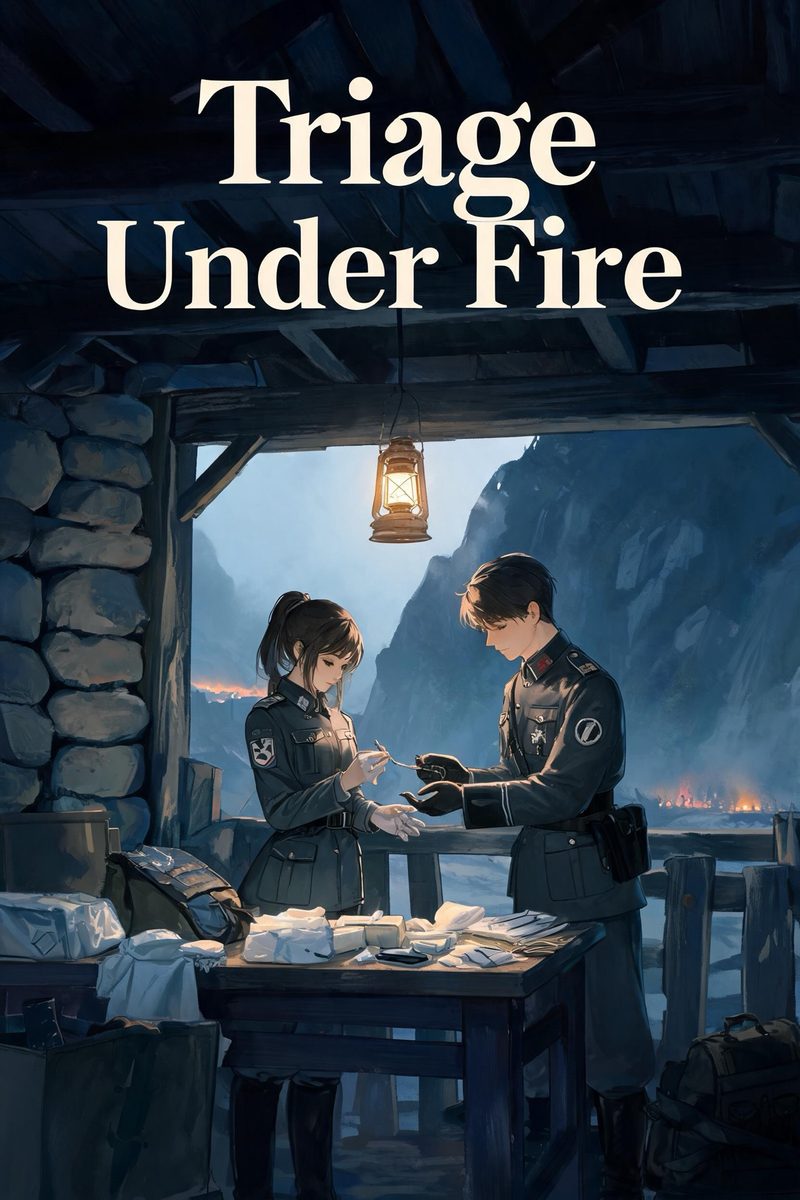
Triage Under Fire
by PageCrave Editorial
When Captain Vera Lin reports to Talon Battalion with a surgical pack and a doctrine nobody asked for, she becomes the first female combat medic ever attached to an elite special operations brigade, and the battalion commander bars her from the line before her boots stop ringing on the parade square.
Major Shen Lie has his reasons, and he keeps them the way he keeps everything: in silence, in logistics, in an order given exactly once. Two years ago a convoy went into Heishui Gorge at night, a medic died at his triage point, and the report buried the question with the man. Since then, no medics on Shen Lie's line. Not on his escort convoys, not in his ambush drills, not in the war that everyone at the border can hear coming. Vera Lin does not accept the ban. She counts her way around it instead, out loud, one number at a time.
Because Vera counts. Under fire, in the dark, in a goat shed with a dying man on a farmer's table, she speaks her ledger into existence: pulse, pressure, tourniquet time, three triage lanes sorted in seconds, red, yellow, green, always in that order. The slower the emergency, the slower her voice. The method works, and working it costs her more than anyone can see, because the ledger counts everyone but the woman keeping it, and a hidden tremor in her surgeon's hand is keeping its own quiet account.
What begins as a barracks turf war becomes a wager: bring me one real mass casualty, she tells him, then sign whatever you like. But the border has its own timetable. The exercises give way to real shells, a mountain pass is sealed with a battalion inside it, and the wager gets paid at a stone barn where one doctor and one table hold a corridor for sixty hours, a commander learning to hand instruments at her count, and a language of flags invented so a half-deaf officer and his medic can keep talking through anything the war invents.
Woven through the campaign runs the question the army refuses to ask: why did medic Jiang Min die at Heishui Gorge, and why does his old commander flinch at a ticking stopwatch? A blue notebook with stopwatch times in the margins. A page torn from its binding, kept for two years by a hospital director who waits for the right pair of hands. An unsigned order in ink that does not match the dead man's pen. A countdown clock on a courteous colonel's desk, and minute marks he quotes in briefings that match a night he was never officially near. Vera inherits her teacher's open count, and the closer she gets to closing it, the closer she stands to the man whose signature bought its silence.
This is a military romance built like a trauma chart: precise, fast, and honest about cost. A heroine who treats pride as breathing, a hero whose love arrives as stretcher space and hot food, a battalion that learns to count, and a reckoning that reaches from a mountain pass to a courtroom to a drill square where a cap changes heads and the debt of two years is finally, publicly paid.
The lanes are open. The count is running. Time is what bleeds, not you.
In our reading guide: The terms were clear. Nobody followed them.