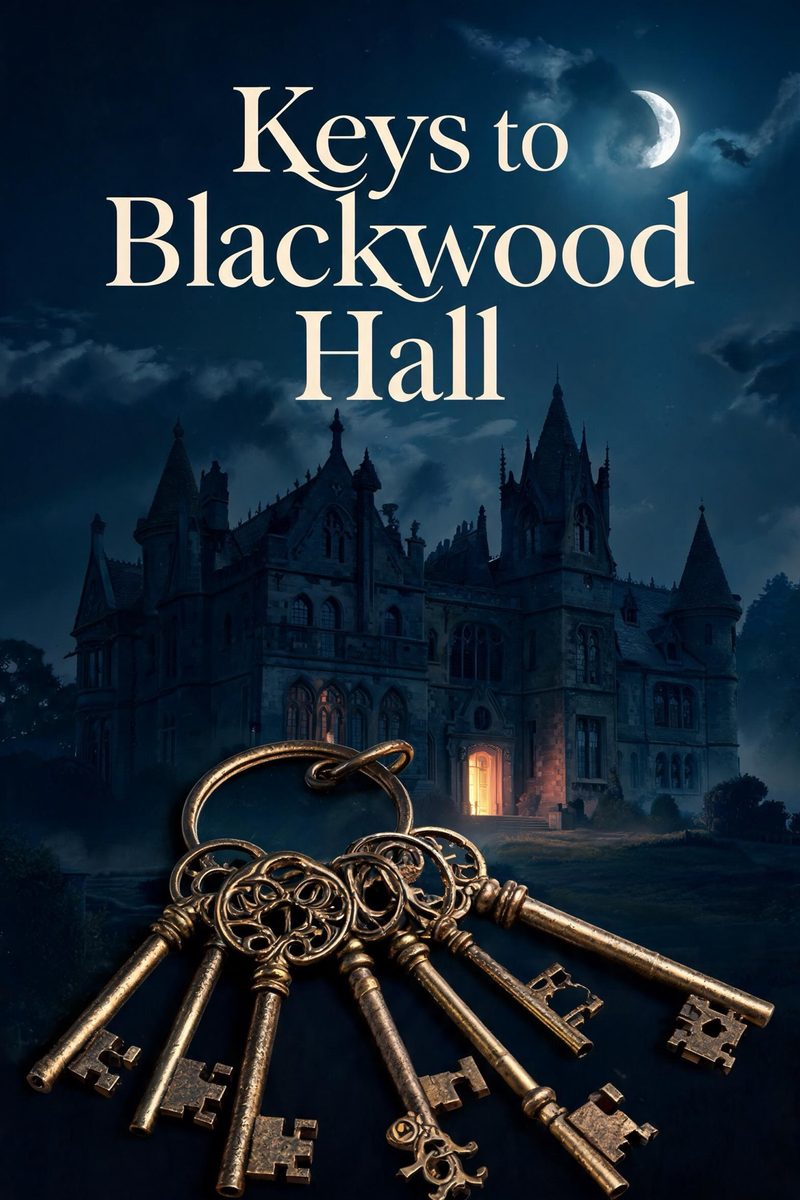
Keys to Blackwood Hall
by PageCrave Editorial
The house has been in trust for thirty years, and now the trust has voted to sell it.
Hazel Wren is twenty-nine, a conservator of old buildings with her father's eye and her father's boxwood rule, and she has spent eleven years believing the worst thing about Edward Wren: that the man whose measured survey saved Blackwood Hall from the wrecker in 1996 was also the man who robbed it. That is what the record says. In 2015 the estate's accounts turned up payments to her father's firm for conservation work no one could find, and Edward Wren ran ahead of a warrant and out of his daughter's life, and the county has called him a thief ever since. Hazel has never believed it, quite. Belief is a thing you can measure, and what she measures is this: the paperwork was too neat.
So she takes a post at Blackwood Hall under a false name. Hazel Pierce, housekeeper, twenty-nine, no references that survive a telephone call and none offered. She arrives with a suitcase, a folded drawing, and her father's last lesson — look where the drawing lies — and she is prepared for dust, damp, and a dying house. What she is not prepared for is the ninth Lord Blackwood.
Alex Blackwood is thirty-six, and the county has spent ten years deciding exactly what he is worth: nothing on paper, less in conversation. His father mortgaged the estate to the roofline; the trust that holds the freehold holds the debts too; and now the sale catalogue is going out with a guide price of one million three hundred thousand pounds and an auction date — the fourteenth of November — that will end nine hundred years of Blackwoods at Blackwood Hall. He has one season to save his house, no money to do it with, and a new housekeeper who measures doorways the way other people lie awake.
The arrangement should be simple. She will keep the house; he will sell it; nobody will compare dates. But Blackwood Hall does not cooperate. The east wing has been sealed for eleven years, on the trust's written order, and someone has been searching it — floorboards up, joists bared, a wall vent scored at with a crowbar — for something they have never found. The estate accounts are a ledger of small unreasonable sums. The chairman of the trust is the soul of propriety and the patient keeper of other people's signatures. And behind a chapel wall, in her father's tin deed box, Hazel finds the proof he left waiting — and the one door it unlocks.
What follows is a courtship conducted in survey notes, auction catalogues, and lies told for the right reasons — an employer and a servants'-hall liar, a class line neither of them can draw honestly, and a slow fire under ten thousand acres of propriety. Because the house keeps what it loves, and it has decided to keep them both: the lord with nothing left, and the thief's daughter who is about to prove that the only thing her father ever stole was the truth — and that he hid it where only a conservator would think to look.
On the fourteenth of November, the gavel falls. The question is whose hands are on the house when it does — and whose name is on the door.
In our reading guide: The terms were clear. Nobody followed them.