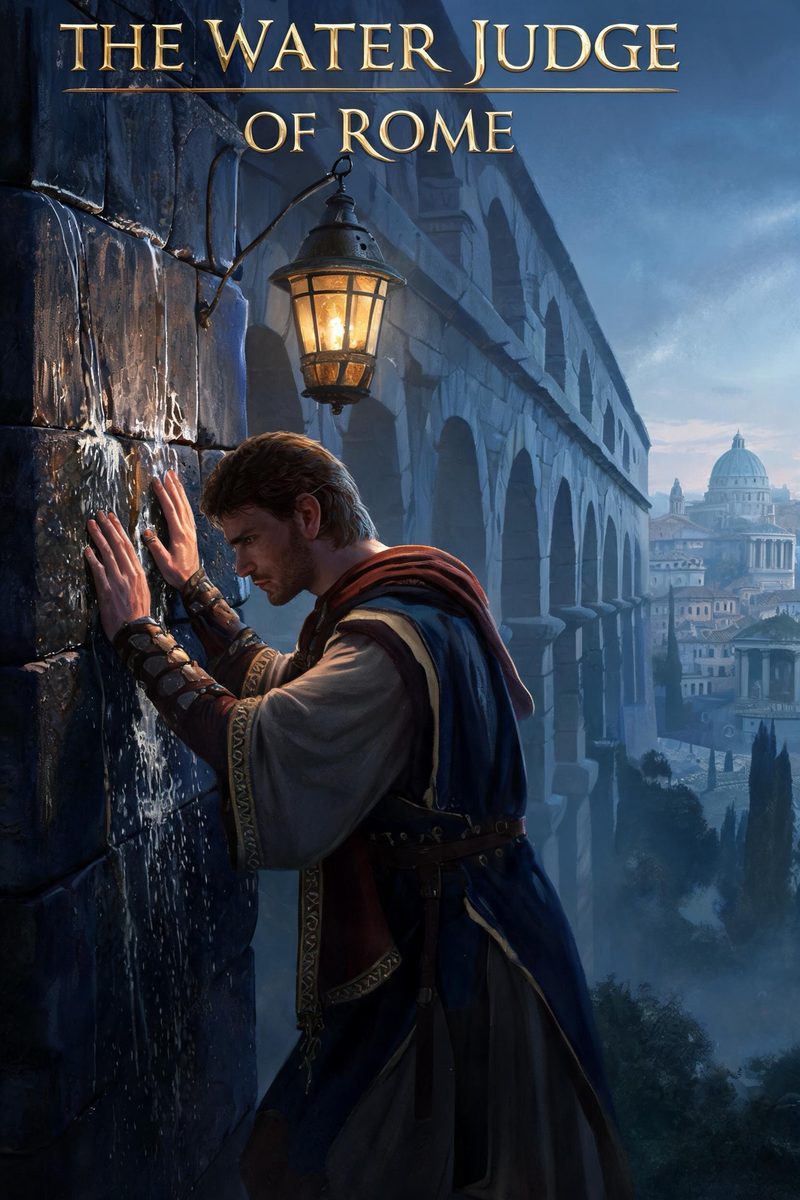
The Water Judge of Rome
by PageCrave Editorial
Rome, in the last years of the emperor Nerva. Eleven aqueducts serve the greatest city on earth, and every one of them lies. The law promises the channels a flow they have never delivered in thirty years — a country's worth of water, gone somewhere between the hills and the fountains. The Senate has read the summaries. The magistrates have taken their fees. And the poor of the fourteen districts have learned to call a dry fountain by the hour it failed.
Gaius Fabricius is the son of a deaf water-man, a surveyor's son with a surveyor's hands, and the newest commissioner of waters — appointed to the office of a man who drowned in his own settling tank three weeks before. The capital calls it an accident. The drowning man's stepdaughter, Vindemia, keeps her father's field-book hidden in a wine jar, and the field-book keeps a column her father ruled and named, in his fair engineer's hand, Gifts.
Gaius has one gift from his father's line, and the gift has a price: when he presses his hands to wet stone, he hears what the water remembers. Every theft, every night-feed, every drowned secret — the water files it all, patient as a ledger. But the Listening spends his hearing coin by coin, and the price only ever rises. One day the trade will fall silent in him forever. He already knows it. He goes down to the water anyway.
What begins as an audit becomes a war fought entirely with instruments. Ring gauges that cannot lie against grants that do nothing else. A secret water court held by lamplight over a black tank. A senator — gray, courteous, untouchable, whose family lake holds forty days of Rome's water behind a wall older than the law — who does not send assassins. He sends lawyers, writs, and a forged counter-audit that agrees with the truth to the fourth decimal, and when paper is not enough, he sends men with powder to bring the aqueducts down in the night.
Against him stands a commissioner with no army: a Thracian diver with a broken-set arm and a cudgel he is not licensed to carry, a clerk who discovers his own filed lies make excellent rope, a trade of tap-fitters who have kept a shrine under the fish market for thirty years, and — when the drought comes and the poor quarters run to air — two thousand guildsmen with chalked wrenches drawn upside down on their doors, the crossed-out sign of a watch that answers to a court and not to a purse.
There will be a rigged counter-audit in the Senate, a trial where the evidence is a jar of water, an emperor who knows exactly how he is being poisoned and has decided to keep schedule anyway, a stolen lake made to walk ten miles to Rome in a ditch, and a public reading where the whole city discovers it has spent the winter drinking the proof.
This is a story of engineers against aristocrats, of a city that never once asked where its water went, and of the man who asked — knowing that Rome would make him pay for the answer with the last of his ears.
Measure twice. The difference is someone's drinking.